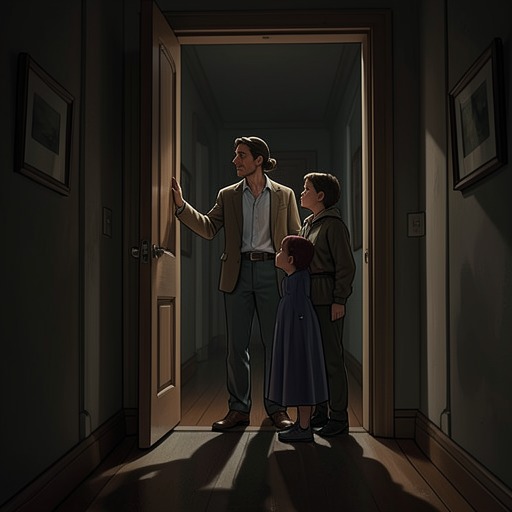
Panic room door access rule
Panic RoomAt Wortalleth West, the panic room’s steel door can be opened only from inside. Its one-way access rule is meant to secure whoever is within, but when the door is found locked it also creates an unsettling question: whether anyone remains behind it. The rule establishes the room’s protection and, at the same time, helps conceal what that protection contains.
Definition and Operation
The door is a sliding steel barrier that can be locked only from the room’s interior. Don Challenor identifies that mechanism when he examines the shut door: if his interpretation is right, it should be open, but it is locked from the inside. The distinction matters because the door is not simply a barrier someone outside can unlock or test at will; opening it requires the choice of an occupant within.
The rule is part of a larger security design. The room is enclosed within the house and walled in steel, with cameras that let an occupant observe the other rooms while remaining hidden from observation. Its security is described as absolute so long as the door stays closed. The design’s protective logic therefore depends on restricted access: the person inside controls whether the boundary opens.
Technical Uncertainty
The door’s appearance does not settle whether a functioning panic room lies behind it. Blake considers that the steel barrier could slide open onto a chamber spanning two floors, but cannot trace the expected electrical connections or air supply. Such a room should have its own shielded cables and pipes, as well as a separate telephone line; Blake cannot tell whether those systems are absent or merely concealed.
Don suggests two possible explanations for the locked door: a fault, or a sequence in which someone triggered the door to close and lock before jumping out. Blake notes that the system should have a fail-safe against that sequence, and that a fault ought to leave the room accessible rather than seal it. These technical expectations make the apparent lock more troubling, but they do not establish that the room is occupied or even that its systems are present.
Consequences in the Investigation
The inside-only rule changes the meaning of a closed door. Don treats the lock as evidence that the barrier has been secured from within, while Blake’s immediate question is whether someone is inside. Yet the mechanism offers no direct confirmation: the room is designed to keep its occupant safe and unseen, and the locked door prevents the investigators from simply entering to resolve their uncertainty.
The rule thus narrows the plausible explanations without providing a solution. A sealed door may point toward an occupant, an anomalous closure, or a concealed fault; the expected fail-safe makes the latter possibilities harder to accept, but the missing technical evidence keeps them open. Protection and concealment become inseparable: the very mechanism intended to make the room secure also makes its condition difficult to know.
Narrative Significance
The door turns a familiar promise of safety into a source of suspense. Before Don identifies the barrier, Blake has decided to invent a threat; the locked door makes the danger real to her, and she suddenly no longer feels safe. The rule’s force lies in this reversal: a room built as refuge becomes a sealed unknown, and the question of who might be inside cannot be answered from outside.